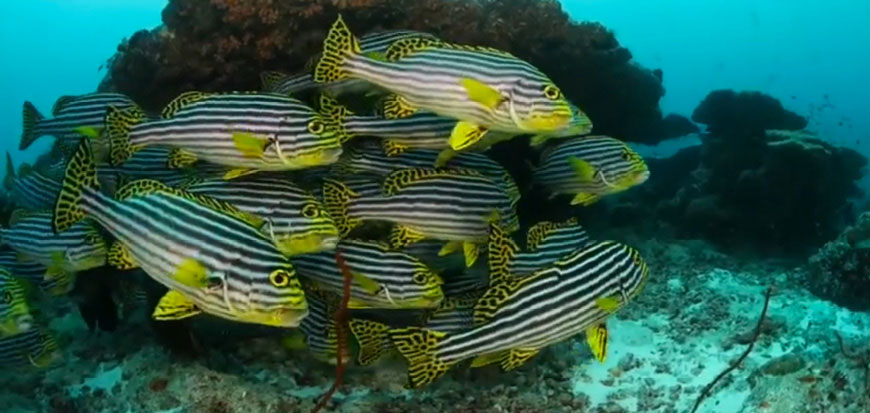

In 2016, composer Stella Sung attended a lecture at the New England Aquarium, learning about the problems of ocean noise pollution caused by seismic testing, the air guns used for this process, large ships and ocean vessels, and other man-made noises.
Stella explains, “The effects of these noises can be devastating for all marine species from fish to plankton, but particularly for those that depend upon sound waves for their communication, finding food sources, and navigation.”
She set about to compose “Oceana,” with the goal of “reminding us of how important the ecosystems of the oceans are for not only marine life but for human life as well.” Stella describes the work as divided into three sections: “1) the beauty, majesty, and mystery of the seas and the life forms that live there, 2) the man-made disturbances of that ecosystem, and 3) the hope that humans can find a balance of living alongside the oceans and marine life so that our co-existence is based upon respect and understanding and knowledge.”
Stella collaborated with scientists and Maestro Christopher Wilkins (Music Director, Akron Symphony and Boston Landmarks Orchestra) on this project. She compiled a soundtrack comprised of recordings of marine life animal sounds (various whale, dolphin, seals, and other sounds) that runs throughout the piece, and she worked with underwater filmmaker Annie Crawley to develop the accompanying film. Together, they’ve made a powerful statement about the beauty of our oceans and the danger human activity poses to this most vital ecosystem.
Take a look at this sneak preview, then experience “Oceana” at Beethoven on the Cape, September 21 and 22. Tickets are going fast but there are still good seats available and you don't want to miss this. Call 508.362.1111 or visit capesymphony.org today.